Just got back From the World Tea Expo 2014. This year, it was held in Long Beach Ca., which was nice for me, as it is a short drive, and I have friends in the area to crash with, so I saved a lot of money I would otherwise had to spend on a hotel room. This was my second year attending. Last year the spouse and I attended the New Business Boot Camp, which included the World Tea Tasting Tour, which I discussed in two parts, here and here.
This year, I went alone. I focused on taking classes, but also did some networking, and talking to vendors. I'd like to have a small stock of teas to offer.
One of my goals at the Expo is to expand and educate my own palate. I mostly focused on tasting single source teas, rather than on blends, or flavored teas. Flavored blends, especially fruity, spicy, and floral teas, are hugely popular in the US. They are, however, kind of the wine coolers of the tea world. Everyone sells them, because that is what people buy, but what we want them to love are the subtle and complex teas, the equivalent of aged varietal wines. I find myself intrigued by the variation within tea, and want to have some ability to guide others.
One thing I love about the Expo is the energy. It has a positive energy unlike any other professional convention I've been to. I think this is because one does not casually become a tea professional. Running a tea business does not top the Forbes list of fast riches jobs. Everyone there is there because of passion. We can all geek out on tea together.
I also love the cosmopolitan nature of the Expo. Not only did I meet great people from all over the US, I talked to people from Canada, Great Britain, New Zealand, Australia, Japan, Korea, China, Taiwan, Sri Lanka, India, Nepal, Thailand, Kenya, Malawi, and more. I love that you have people in every attire from three piece business suits to cargo shorts and tie-die t-shirts happily chatting.
I will write more on the classes I had the opportunity to take, and some of the products and companies.
Showing posts with label Tea. Show all posts
Showing posts with label Tea. Show all posts
Monday, June 2, 2014

Tuesday, October 15, 2013
Black Hat Tea 2013: The Savory Course
It's fall again, time once more for the spouse to hold her Black Hat Society Tea. Last year, the signature fall flavor was apple. This year, we decided that pear should be the featured flavor would be pear. I think we had about twice as many people attending. I want to thank the two friends that helped me in the kitchen, one acting as my sous chef, and the other washing dishes and keeping tea pots flowing. Also, a huge thank you to Rebecca Freeburn of Freeburn inc. who came out and took great photos of the food.
 For the savory course, we served three items. We had a number of people attending that were gluten free, so only served one tea sandwich, and added a soup and a salad.
We opened with a soup. This was a shooter of a cold spicy pecan soup, with a garnish of a little chipotle pepper. This soup is pecans simmered in vegetable stock, and flavored with chipotle peppers in adobo sauce, garlic, onion, and cilantro. It is then thickened with heavy cream. I rinsed the adobo sauce off some of the peppers, and then cut them into fine ribbons as a garnish.
I was very happy with this soup. I got just enough spice to notice, without it being overwhelming. It was very rich, and the cream gave it a luscious mouth feel.
I also made a vegan version, where I used almond milk instead of the cream. It was also very good. It was a bit sweeter, and did not have quite as silky a texture.
 The next item was a tea sandwich of walnut onion bread with slices of pear and Gorgonzola cheese.
The bread is a yeast bread with onions and pieces of walnuts. I alternated slices of red and Bartlett pears, leaving the skin on for the color. I added the Gorgonzola crumbles.
The flavor combinations were good. I think next time I will cut the bread a trifle thicker, and toast it. I might also work the Gorgonzola into some cream cheese and make a spread.
 The last item was a three bean salad with a vinaigrette of date vinegar and olive oil, flavored with basil mustard and herbs.
I used black, kidney, and garbanzo beans. There is some minced red onion mixed in.
The dressing is a vinaigrette using date vinegar and olive oil. I added some Trader Joe's Basil Mustard. I also added dried basil, oregano, rosemary, and thyme.
The salad was served in half of a miniature sweet pepper. I added a chiffonade of fresh basil as a garnish.
2 Tbsp. olive oil
1/2 cup minced onion
3 Tbsp. minced garlic
6 cups vegetable stock
2 Tbsp. lemon juice
3 cups pecan pieces
3 Tbsp. canned chipotle chilies in adobo sauce, minced
1 Tbsp. dried cilantro
2 cups heavy cream
salt to taste
In a stock pot over medium heat, add olive oil. Saute onion and garlic until tender. Add stock, juice, pecans, chilies, and cilantro. Simmer for two hours. Using an immersion blender, blend until smooth. Place pan in an ice bath to cool. Refrigerate soup until time for service. Stir in cream. Adjust salt as needed.
This soup can be made vegan by replacing the cream with the same amount of almond milk.
3/4 cup finely chopped onion
2 cups warm water (105°F. to 115°F.)
2 tablespoons sugar
2 envelopes dry yeast
2 teaspoons salt
5 cups (about) bread flour
3 oz. by wt. walnut pieces
In a skillet over medium to medium high heat, add walnut oil. Add onion, and saute until tender. Set aside to cool.
Combine water, yeast, and sugar. Let stand until foamy.
Sift flour. Place yeast mixture in the bowl of a food processor with onions, salt, and 1 cup of flour. Pulse to combine. Add flour 1 cup at a time, processing after each addition. Do this until dough forms a smooth ball. (My food processor was straining before I got that far. I kneaded the last cup or so in by hand.)
Transfer the dough to a well floured surface. Need until dough is smooth and elastic, about 10 minutes. Add flour as necessary to keep dough from sticking.
Oil a bowl with walnut oil. Place dough in bowl, rotate to coat surface with oil. Cover, let rise until doubled in size.
Punch down dough, let rest for five minutes.
Transfer to a well floured surface. Roll out to about 1 inch thick. Spread walnuts evenly over surface. Knead dough to incorporate walnuts.
Coat the insides of two loaf pans with oil. Divide dough in half. Shape each half into an oblong, place each oblong in a loaf pan. Cover, let rise until doubled in size.
Pre-heat oven to 400 F. Bake about twenty five minutes, until golden brown and it sound hollow when thumped. (I think next time, I will try it at 375 F, and bake it longer. I'd like to see if I can get the bottom a bit crisper.)
Remove from oven, place on wire racks to cool.
1/2 large red onion, diced
4 oz. by vol. date vinegar
12 oz. by vol. olive oil
1 1/2 Tbsp. Basil Mustard
1 tsp. dried basil
1 tsp. dried oregano
1 tsp. dried rosemary
salt and pepper to taste
Drain beans, and rinse thoroughly. Place in a bowl, stir in onion. In another bowl, whisk together vinegar, mustard, and herbs. While whisking vigorously, slowly add oil, until dressing thickens. If necessary, a little water can be added to thin it out.
Pour dressing over beans. Mix. Refrigerate until service.
Happy eating!
 For the savory course, we served three items. We had a number of people attending that were gluten free, so only served one tea sandwich, and added a soup and a salad.
We opened with a soup. This was a shooter of a cold spicy pecan soup, with a garnish of a little chipotle pepper. This soup is pecans simmered in vegetable stock, and flavored with chipotle peppers in adobo sauce, garlic, onion, and cilantro. It is then thickened with heavy cream. I rinsed the adobo sauce off some of the peppers, and then cut them into fine ribbons as a garnish.
I was very happy with this soup. I got just enough spice to notice, without it being overwhelming. It was very rich, and the cream gave it a luscious mouth feel.
I also made a vegan version, where I used almond milk instead of the cream. It was also very good. It was a bit sweeter, and did not have quite as silky a texture.
 The next item was a tea sandwich of walnut onion bread with slices of pear and Gorgonzola cheese.
The bread is a yeast bread with onions and pieces of walnuts. I alternated slices of red and Bartlett pears, leaving the skin on for the color. I added the Gorgonzola crumbles.
The flavor combinations were good. I think next time I will cut the bread a trifle thicker, and toast it. I might also work the Gorgonzola into some cream cheese and make a spread.

I used black, kidney, and garbanzo beans. There is some minced red onion mixed in.
The dressing is a vinaigrette using date vinegar and olive oil. I added some Trader Joe's Basil Mustard. I also added dried basil, oregano, rosemary, and thyme.
The salad was served in half of a miniature sweet pepper. I added a chiffonade of fresh basil as a garnish.
Recipes
Spicy Cold Pecan Soup
2 Tbsp. olive oil
1/2 cup minced onion
3 Tbsp. minced garlic
6 cups vegetable stock
2 Tbsp. lemon juice
3 cups pecan pieces
3 Tbsp. canned chipotle chilies in adobo sauce, minced
1 Tbsp. dried cilantro
2 cups heavy cream
salt to taste
In a stock pot over medium heat, add olive oil. Saute onion and garlic until tender. Add stock, juice, pecans, chilies, and cilantro. Simmer for two hours. Using an immersion blender, blend until smooth. Place pan in an ice bath to cool. Refrigerate soup until time for service. Stir in cream. Adjust salt as needed.
This soup can be made vegan by replacing the cream with the same amount of almond milk.
Onion Walnut Bread
1/2 cup walnut oil3/4 cup finely chopped onion
2 cups warm water (105°F. to 115°F.)
2 tablespoons sugar
2 envelopes dry yeast
2 teaspoons salt
5 cups (about) bread flour
3 oz. by wt. walnut pieces
In a skillet over medium to medium high heat, add walnut oil. Add onion, and saute until tender. Set aside to cool.
Combine water, yeast, and sugar. Let stand until foamy.
Sift flour. Place yeast mixture in the bowl of a food processor with onions, salt, and 1 cup of flour. Pulse to combine. Add flour 1 cup at a time, processing after each addition. Do this until dough forms a smooth ball. (My food processor was straining before I got that far. I kneaded the last cup or so in by hand.)
Transfer the dough to a well floured surface. Need until dough is smooth and elastic, about 10 minutes. Add flour as necessary to keep dough from sticking.
Oil a bowl with walnut oil. Place dough in bowl, rotate to coat surface with oil. Cover, let rise until doubled in size.
Punch down dough, let rest for five minutes.
Transfer to a well floured surface. Roll out to about 1 inch thick. Spread walnuts evenly over surface. Knead dough to incorporate walnuts.
Coat the insides of two loaf pans with oil. Divide dough in half. Shape each half into an oblong, place each oblong in a loaf pan. Cover, let rise until doubled in size.
Pre-heat oven to 400 F. Bake about twenty five minutes, until golden brown and it sound hollow when thumped. (I think next time, I will try it at 375 F, and bake it longer. I'd like to see if I can get the bottom a bit crisper.)
Remove from oven, place on wire racks to cool.
Three Bean Salad
1 large can each kidney, black, and garbanzo beans1/2 large red onion, diced
4 oz. by vol. date vinegar
12 oz. by vol. olive oil
1 1/2 Tbsp. Basil Mustard
1 tsp. dried basil
1 tsp. dried oregano
1 tsp. dried rosemary
salt and pepper to taste
Drain beans, and rinse thoroughly. Place in a bowl, stir in onion. In another bowl, whisk together vinegar, mustard, and herbs. While whisking vigorously, slowly add oil, until dressing thickens. If necessary, a little water can be added to thin it out.
Pour dressing over beans. Mix. Refrigerate until service.
Happy eating!
Saturday, August 31, 2013
Ladies of the Rose Tea
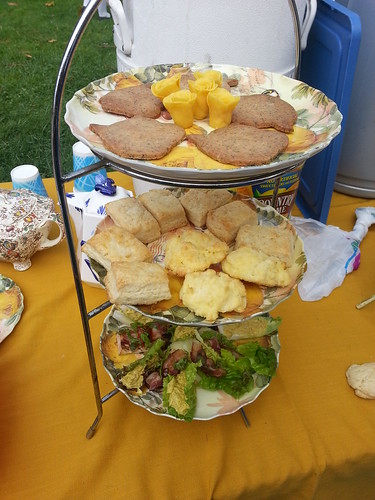 Within the medieval group I play with, there is a group of women that have served previously as Queen. They are know as the Ladies of the Rose, and their symbol is a yellow rose. I suggested to the current queen that I'd like to do a tea for these ladies. She thought this sounded like a great idea.
Now, there is nothing remotely medieval or renaissance about a formal tea. It is a Victorian invention. However, our group has strong roots in Victorian Gothic Romanticism. I don't think it is a great sin to acknowledge that. Besides, how cool is it to sit in the shade, nibble delicacies, and chat the afternoon away?
The Queen expressed a preference for leaning toward savory. I tried to pick a menu that reflected that.
For the savory course, we made two items. For the first, I did a riff on the classic BLT. When shopping at the El Cajon Farmer's Market, I found a little local company, Jackie's Jams. She had a tomato jam, and I just had to try it. It was really good, and I bought a jar. I thought it
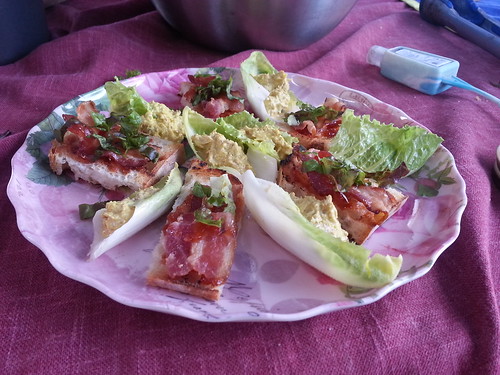
The second savory item was a lettuce cup with curried tuna salad. The intent was to use all endive, but the head we bought didn't have quite enough leaves, so I used some heart of romaine as well. The tuna is a simple mix of canned tuna, mayonnaise, curry powder, and hot curry paste.
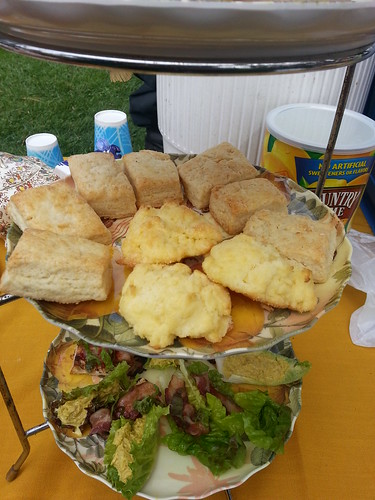
I also made some gluten free scones, as we had an attendee that was gluten intolerant. The gluten free scones were made with Bisquick Gluten Free Mix. I followed the biscuit recipe on the box, but substituted heavy cream for the milk, to get a richer scone.
We then made a choice of four toppings, two savory and two sweet. For the savory, I made a chili lime butter, and a pesto butter. For the sweet, I made kiwi curd and the spouse made mock Devonshire cream. The kiwi curd was sweeter than I'd expected, and set up a little soft, but it seemed to be popular.
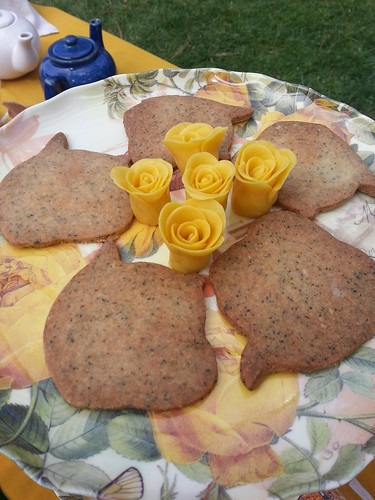 For the sweet course, the spouse made rose tea shortbread cookies, and I made safflower infused white modeling chocolate roses.
 I wanted to make yellow roses, and I'd hoped to use natural color to do it. I originally planned to use saffron, but realized I was out, and couldn't find any on short notice, but safflower was easily available. I couldn't get a deep enough color, so added some commercial coloring paste. The safflower added a bit of a savory note to the rather sweet modeling chocolate. Modeling chocolate is just white chocolate and corn syrup.
I included instructions for making a modeling chocolate rose in this post.
Recipes
Curried Tuna Salad
3 cans tuna, drained1/2 cup mayonnaise
1 Tbsp. curry powder
1 1/2 tsp. hot curry paste
salt to taste
In a bowl, mix all ingredients until tuna is well moistened.
Chili Lime Butter
8 oz. by wt. butter, softened1 ripe jalapeno chili
zest of 6 key limes
juice of two key limes
kosher salt to taste
Char outside of chili over open flame. Remove skin, seeds, and inner membranes. Mince.
Mash together butter, chili, zest, juice, and salt until well blended.
Pesto Butter
8 oz. by wt. butter1 cup fresh basil leaves
1/4 cup pine nuts
1/4 cup grated Parmesan cheese
1 tsp. minced garlic
kosher salt to taste
Place all ingredients in a food processor. Run until butter is smooth.
Kiwi Curd
1 cup sugar
4 eggs, beaten
1/2 cup kiwi fruit puree
pinch kosher salt
Combine all ingredients in a small sauce pan over medium low heat. Cook, whisking constantly, until curd thickens, about ten minutes.
Strain curd. cover surface with plastic wrap to prevent a skin from forming. Chill in freezer for 20 minutes, then transfer to refrigerator to finish cooling.
Mock Devonshire Cream
8 oz. by wt. cream cheese1 cup heavy cream
1/2 cup powdered sugar
1/2 cup sour cream
1 tsp. vanilla extract
In the bowl of a stand mixer, whip cream cheese until fluffy. Add rest of ingredients, whisk until stiff peaks form.
Rose Tea Cookies
1 cup flour1/4 cup sugar
1/4 cup powdered sugar
1 tbsp. Scottish Breakfast tea
1/4 tsp. salt
1/2 tsp. vanilla
2 Tbsp. water
1/4 tsp. rose water
1/2 cup butter
Pre-heat oven to 375 degrees.
Mix together rose water and water. Set aside.
In the bowl of a food processor, pulse together flour, sugars, salt, and tea leaves until tea is well incorporated. Add vanilla, 1 tsp. of the diluted rose water, and butter. Pulse until a dough forms.
On a floured surface, roll dough very thin. Cut out cookies, place on an ungreased sheet pan. Bake until crisp, about 10 minutes. Cool on a rack.
Safflower Infused Modeling Chocolate
1 cup corn syrup1 cup safflowers
10 oz. by wt. white chocolate
In a microwave safe bowl, combine corn syrup and safflowers. Heat in microwave until syrup just begins to boil.
Remove from microwave. Let cool to room temperature. Strain.
In a double boiler, melt chocolate to 100 F. Add 1/3 cup of the safflower infused corn syrup. Mix with a spatula until smooth and shiny. Let stand at least 4 hours before using. If kept refrigerated, good for up to one month.
Combine with rubber spatula until smooth and shiny. Let sit 4 hours to over night.
Happy Eating!
Wednesday, June 12, 2013
World Tea Expo: World Origin Tasting Tour Part 2, the afternoon
For the teas we tasted in the morning, go here.
After a morning of tasting many interesting teas, they fed us a nice lunch. As a bonus, I got to have an extended and very interesting conversation with my new tea guru crush, Jane Pettigrew. Once we were fed, we returned to the tasting rooms.
 Our first country of the day was Japan. The presenter for Japan was Rona Tison of ITO EN. When we got to our table, there was the additional little gift of a can of Sencha Shot. It is a little can of ready to drink green tea. I did not drink it at the time. In fact, I only got around to trying it yesterday, with my breakfast. Now, I am probably not the target audience for the product, but, in my opinion, it was awful. It had a decent front flavor of green tea, but it had a terrible way over brewed aftertaste. It was incredibly bitter. Anyway, Japan is all about the green tea. They don't make any oxidized teas at all, apparently. The first tea we sampled was a Megami Sencha. I found it to be a pale green gold in color, with a strong asparagus nose, a light clean attack, a moderately herbaceous middle with a hint of honey, and a clean, lightly tannic finish. The spouse found it to have a vegetable nose rich in umami, gentle and fresh on the tongue. The second tea was a Genmaicha. This tea blends green tea with roasted rice. I found it to be a very pale green gold color, with a nose reminiscent of popcorn, a mildly nutty attack, and a mildly lingering finish. The spouse found it to have a toasted scent and taste. The third tea was a Hojicha.
This is a green tea that has been roasted. I found it to be a bright orange color, with a mildly smoky nose, and a smoky attack, with a strong taste of umami in the middle. The spouse found it to have a mildly vegetable and woodsy nose, with some astringency on the attack, and a sense of umami on the tongue. The last tea we tasted was the quintessential Japanese tea, Matcha. Matcha is the finely powdered green tea used in the tea ceremony. It produces a cloudy, dark green tea. I found it to have a strong vegetable nose and attack, with a bitter finish. The spouse found it to have a strong green vegetable/grassy nose, and an astringent attack with a bitter finish.
The next to last country of the day was Nepal. The presenters were Chandra Bhushan and Rob Burnett of Nepali Tea Traders. Similar to Ajiri Tea, a significant part of the profits for Nepali Tea Traders are used to improve conditions for the children of Nepal. The first tea we tasted was a Dhulagiri Spring White Tea. This was a first flush tea, meaning it was made from the earliest new shoots of spring. It was a pale gold tinged green. I found it to have a strong nose of steamed edemame, with a mildly floral attack, a mildly edemame middle, and a clean, slightly lingering finish. The spouse found it to have a light edemame nose, with an edemame flavor and a mildly astringent finish. The second tea was a Half Moon Pearl Green Tea. It was a bright gold color, and I found it to have a cooked green bean nose, with a clean attack and slightly tannic finish. The spouse noted that it had a light vegetable nose, and that it was more astringent and tannic than the white tea. The third and final tea from Nepal was a Wild Yeti oolong. It was a red brown amber color. I found it to have a mildly caramel nose, with a lightly caramel attack and a clean finish with some lightly lingering tannins. I noted that it would match well with a crème brulee. The spouse found it to have a nose with a bit of burned caramel or molasses, and found the finish a bit faint. She felt a little sweetener might bring out this tea's best qualities.
Our last country was Taiwan. The presenter was Thomas Shu of ABC Tea. The focus of this presentation was on oolong teas. Mr. Shu's wife got things going with a rousing cheerleader style chant about Taiwan oolong tea. At that point, we probably needed the infusion of energy. The first tea we tasted was a Taiwan Pouchong. This was a lightly oxidized oolong. It was a bright green gold color. It had a strongly floral nose with notes of yeast, a clean attack, subtle middle, and a lingering jasmine finish. The spouse found it to have a floral nose, with a floral attack and a clean, slightly astringent, finish. She notes it would pair well with a light dessert, or dim sum. The second tea was a Taiwan Jade oolong. This too was a lightly oxidized oolong, with a bright green gold color. I found that it had a roasted green pepper nose, with a crisp attack, a strong taste of edemame in the middle, and a clean, slightly tannic lingering finish, with notes of kalamata olive. I thought it would pair well with a tapenade. The spouse found it a little smoky, with a light edemame taste, and found it to leave a little astringency in the back of her throat. Our penultimate tea of the day was an Amber oolong. This was a more heavily oxidized oolong, and produce an orange brown amber liquor. I found it to have roasted nut and grass notes on the nose, with a light attack, a malty middle, and a strongly tannic lingering finish. The spouse found it to have roasted nose and attack, with a malty middle and a lightly astringent finish. She suggests it would be good brewed strong and poured over ice. With the last tea of the day, we definitely finished on a high note. The final tea was an Oriental Beauty Formosa Oolong. We were told it went at auction in Hong Kong for 100,000 Hong Kong dollars for 600 g. That translates to just under $700 an ounce. This was a more heavily oxidized oolong, and produced a bright orange amber liquor. I found citrus and orange blossom on the nose, with a strong attack, notes of citrus, honey, and leather in the middle, and a mildly tannic floral lingering finish. The spouse found it to be lightly floral, with a light astringency on the finish.
 After the tea, we were treated to dinner, and they had certificates of completion waiting for us. It was
a last chance to bond and chat, and they had us all sign a big poster destined for their office. It was a great, if full, day.
After a morning of tasting many interesting teas, they fed us a nice lunch. As a bonus, I got to have an extended and very interesting conversation with my new tea guru crush, Jane Pettigrew. Once we were fed, we returned to the tasting rooms.

This is a green tea that has been roasted. I found it to be a bright orange color, with a mildly smoky nose, and a smoky attack, with a strong taste of umami in the middle. The spouse found it to have a mildly vegetable and woodsy nose, with some astringency on the attack, and a sense of umami on the tongue. The last tea we tasted was the quintessential Japanese tea, Matcha. Matcha is the finely powdered green tea used in the tea ceremony. It produces a cloudy, dark green tea. I found it to have a strong vegetable nose and attack, with a bitter finish. The spouse found it to have a strong green vegetable/grassy nose, and an astringent attack with a bitter finish.
The next to last country of the day was Nepal. The presenters were Chandra Bhushan and Rob Burnett of Nepali Tea Traders. Similar to Ajiri Tea, a significant part of the profits for Nepali Tea Traders are used to improve conditions for the children of Nepal. The first tea we tasted was a Dhulagiri Spring White Tea. This was a first flush tea, meaning it was made from the earliest new shoots of spring. It was a pale gold tinged green. I found it to have a strong nose of steamed edemame, with a mildly floral attack, a mildly edemame middle, and a clean, slightly lingering finish. The spouse found it to have a light edemame nose, with an edemame flavor and a mildly astringent finish. The second tea was a Half Moon Pearl Green Tea. It was a bright gold color, and I found it to have a cooked green bean nose, with a clean attack and slightly tannic finish. The spouse noted that it had a light vegetable nose, and that it was more astringent and tannic than the white tea. The third and final tea from Nepal was a Wild Yeti oolong. It was a red brown amber color. I found it to have a mildly caramel nose, with a lightly caramel attack and a clean finish with some lightly lingering tannins. I noted that it would match well with a crème brulee. The spouse found it to have a nose with a bit of burned caramel or molasses, and found the finish a bit faint. She felt a little sweetener might bring out this tea's best qualities.
Our last country was Taiwan. The presenter was Thomas Shu of ABC Tea. The focus of this presentation was on oolong teas. Mr. Shu's wife got things going with a rousing cheerleader style chant about Taiwan oolong tea. At that point, we probably needed the infusion of energy. The first tea we tasted was a Taiwan Pouchong. This was a lightly oxidized oolong. It was a bright green gold color. It had a strongly floral nose with notes of yeast, a clean attack, subtle middle, and a lingering jasmine finish. The spouse found it to have a floral nose, with a floral attack and a clean, slightly astringent, finish. She notes it would pair well with a light dessert, or dim sum. The second tea was a Taiwan Jade oolong. This too was a lightly oxidized oolong, with a bright green gold color. I found that it had a roasted green pepper nose, with a crisp attack, a strong taste of edemame in the middle, and a clean, slightly tannic lingering finish, with notes of kalamata olive. I thought it would pair well with a tapenade. The spouse found it a little smoky, with a light edemame taste, and found it to leave a little astringency in the back of her throat. Our penultimate tea of the day was an Amber oolong. This was a more heavily oxidized oolong, and produce an orange brown amber liquor. I found it to have roasted nut and grass notes on the nose, with a light attack, a malty middle, and a strongly tannic lingering finish. The spouse found it to have roasted nose and attack, with a malty middle and a lightly astringent finish. She suggests it would be good brewed strong and poured over ice. With the last tea of the day, we definitely finished on a high note. The final tea was an Oriental Beauty Formosa Oolong. We were told it went at auction in Hong Kong for 100,000 Hong Kong dollars for 600 g. That translates to just under $700 an ounce. This was a more heavily oxidized oolong, and produced a bright orange amber liquor. I found citrus and orange blossom on the nose, with a strong attack, notes of citrus, honey, and leather in the middle, and a mildly tannic floral lingering finish. The spouse found it to be lightly floral, with a light astringency on the finish.
 After the tea, we were treated to dinner, and they had certificates of completion waiting for us. It was
a last chance to bond and chat, and they had us all sign a big poster destined for their office. It was a great, if full, day.
Tuesday, June 11, 2013
World Tea Expo: World Origin Tasting Tour Part 1, the morning
Friday of the World Tea Expo we attended the World Origin Tasting Tour as part of the New Business Boot Camp. The set up was very well done from a logistics stand point. They set it up so that there were two rooms. We would be in one room tasting one countries teas, as they set up the other for the next country. When we finished tasting a country, we would have a short break, then move to the other room. The staff of volunteers did an excellent job of keeping things moving. Over the course of the day, I calculate they brewed between 500 and 600 pots of tea. With each pot of tea, they also brought out both dry and wet leaves, in properly labeled containers, so you could see/smell them. They provided alternately banana pieces or bland crackers to help clear the palate. I might suggest for the future to also provide water, but I've done wine tastings, so knew to bring my own.
 They provided notebooks and a great little passport book listing all the teas by country that we would be tasting, with space for notes for each. A neat bit in the passports was that next to each tea was an annotation for how much tea per 18 oz. water to use, how long to steep each tea, and the proper temperature water to use for each tea. Each country had an expert to guide us, and the whole thing was MC'd by Jane Pettigrew.
Logistically, this was a very well run event. They kept things moving, got tea delivered in a timely manner, kept everyone supplied with cups, and generally kept things informative and fun. The individual experts were all enthusiastic about their country's products, and were informative and lively.
The first country we visited was China. This was appropriate, since China is the birthplace of tea cultivation. The presenter for China was Austin Hodge of Seven Cups. We tasted six teas from China, the most of any country. Our first tea was a Silver Needle white tea. My notes say it was a golden yellow color, grassy, mildly smoky, with a vegetable taste reminiscent of cooked broccoli stem. The spouse's notes call it a particularly flavorful white tea with a spinachy smell and a sharp flavor. She notes it should pair well with rich savory foods. Our second tea was an Anji Bai Cha green tea. My notes say it was a very pale yellow, with a strong smell of asparagus on the nose, a mildly sweet attack, and bitter finish with a hint of lilac. The spouse's notes call it slightly floral, with an asparagus smell and taste, lightly sweet(lilac) on the finish. She feels it would pair nicely with foods rich in umami, like mushrooms or braised beef. The third Chinese tea was a Golden Guan Yin oolong. My notes say it was a light golden yellow with a light vegetable nose, a floral attack with notes of rose, and a mild finish. The spouse's notes say it had a mildly sharp attack, with a lightly floral finish. She thinks it would work best with more subtly flavored savory foods. Our fourth Chinese tea was a Zheng Yan Da Hong Po oolong. My notes say it had a reddish orange amber color, with a fruity nose with a smoky under note. It had a mildly fruity attack, a smoky middle, and a bitter finish, The spouse found it to have a light vegetable(green) nose with an astringent, bold flavor with a toasted effect.. She felt it would match well with either savory or sweet foods. The penultimate Chinese tea was a Snow Mountain Sheng Puerh. I found it to be a pale orange amber in color, with a smoky nose with notes of tobacco, and a smoky attack with a bitter green finish reminiscent of kale. The spouse found it to have a smoky nose, with a kale like bitterness on the finish.. Our last Chinese tea was a Gong Fu Dian Hong black tea. This was the one reasonably priced Chinese tea we tasted. I found it to be a dark red amber color, with a minimal nose with a hint of smoke. I called it a solid, not complex tea, with a mildly bitter finish. The spouse called it a standard tea flavor stronger than Lipton, with a sweet finish.
Our second country was Sri Lanka, and the presenter was Royce Van Twest of QTrade Teas & Herbs. Our first tea was a Super Pekoe black tea. My notes call it a red amber color with a mildly mineral nose, a lightly fruity attack, not complex middle, and a mildly bitter finish. The spouse found it to have a very slightly vegetable nose, mildly astringent with a clean finish, but leaving an astringency in the back of the throat. Our second tea was a Idulgashinna Green Orange Pekoe 1. I found it to be a pale greenish gold color, with a vegetable nose with notes of asparagus, a mildly vegetable taste with no bitterness on the finish. The spouse found it to have a mild flavor with a neutral astringent finish. She suggests it would pair best with delicate flavors. Our third tea from Sri Lanka was a Kirkoswald Silver Needle white tea. It was a pale yellow gold color. I found it to have a sweet floral nose, with notes of violets, a mildly vegetable attack with notes of celery, and a clean finish. The spouse found it to have a pleasant aroma with a very floral nose and a smooth violet flavor. She suggests pairing it with light flavors. Our last tea was a Low Country black tea. It had a red amber color. I found it to be robust, not complex, with a clean finish with very little bitterness. The spouse notes it to have a mild nose with nothing distinctive, and to be robust. She notes it should pair with anything.
From Sri Lanka we moved on to Kenya. The presenter here was Sara Holby of Ajiri Teas. The presentation here was significantly different than the others. First, the focus of the presentation was the company, not the teas. Ajiri Tea is a not for profit, whose main goal is employment of women, and uses any profits towards the education of local children. The passport section for Kenya is the only one with out brewing instructions. Also, this is the only country whose teas were produced by the Cut Tear Curl (CTC) method, which is a machine harvesting and production method. This results in lower labor costs, but also less precision in the quality control of the tea. The first tea was a Momul black tea. I found it to be medium orange amber, with artichoke notes on the nose, a light attack, bright flavor, and a clean finish with a hint of berry. The spouse notes it as artichoke with more pungency, with a bit of bitterness in the back of the throat, and would pair well with sweet scones. The second tea was a Gacharage black tea. I note it as a dark orange amber color, light asparagus nose, with a stronger attack and a mildly bitter finish. The spouse notes an artichoke nose, and more flavor than the Momul. The last was a Nyansiongo black tea. I found it to be a medium orange amber, with a mild asparagus nose, light attack, and mild finish. The spouse also noted a hint of asparagus on the nose.
Our last country before lunch was India. The presenter here was Devan Shah of International Tea Importers. Our first tea was a Malty Assam black tea from the Mangalam Estate. I found it to be a light orange amber in color, with a mild nose, a light attack with a light malt middle with a moderately tannic finish with notes of leather. The spouse found it to have a light flavor, a little malty, with a hint of artichoke on the finish. She found it a bit rough, and felt it would be best with milk and sugar. The second Indian tea was an organic First Flush Darjeeling DJ-1 black tea from Risheehat. I found it to be a light orange gold color, with a strong artichoke nose, light clean attack, floral middle with notes of rose and lavender, and a mildly tannic finish. The spouse found it have a clean attack with a lightly floral and spicy middle with a hint of lavender. The third tea was a Second Flush Darjeeling Muscatel black tea from Singbulli. I found it to be an orange amber color reminiscent of an aged scotch. I found it to have a lemon grassy nose, with a light clean attack, a bright floral middle with notes of violet, and a moderately tannic finish. The spouse found it to have a light lemon grass scent, with an astringent attack, and a kale like flavor. She felt it would pair well with a fatty dessert like a shortbread, to help cut the fat. The last tea before lunch was a High Grown Nilgiri black tea from the Tigerhill Estate. I found it to be a medium orange amber color, with a floral lilac nose, a moderate attack, notes of chocolate and menthol in the middle, and a lightly tannic, lingering finish. The spouse found it lightly astringent, the least tannic of the Indian teas, pleasant to sip. She notes it would make a very good ice tea.
From here we went to a very nice lunch, where I got to have a very pleasant extended chat with Jane Pettigrew. As this has gotten long, I will make another post discussing the afternoon session.

Logistically, this was a very well run event. They kept things moving, got tea delivered in a timely manner, kept everyone supplied with cups, and generally kept things informative and fun. The individual experts were all enthusiastic about their country's products, and were informative and lively.
The first country we visited was China. This was appropriate, since China is the birthplace of tea cultivation. The presenter for China was Austin Hodge of Seven Cups. We tasted six teas from China, the most of any country. Our first tea was a Silver Needle white tea. My notes say it was a golden yellow color, grassy, mildly smoky, with a vegetable taste reminiscent of cooked broccoli stem. The spouse's notes call it a particularly flavorful white tea with a spinachy smell and a sharp flavor. She notes it should pair well with rich savory foods. Our second tea was an Anji Bai Cha green tea. My notes say it was a very pale yellow, with a strong smell of asparagus on the nose, a mildly sweet attack, and bitter finish with a hint of lilac. The spouse's notes call it slightly floral, with an asparagus smell and taste, lightly sweet(lilac) on the finish. She feels it would pair nicely with foods rich in umami, like mushrooms or braised beef. The third Chinese tea was a Golden Guan Yin oolong. My notes say it was a light golden yellow with a light vegetable nose, a floral attack with notes of rose, and a mild finish. The spouse's notes say it had a mildly sharp attack, with a lightly floral finish. She thinks it would work best with more subtly flavored savory foods. Our fourth Chinese tea was a Zheng Yan Da Hong Po oolong. My notes say it had a reddish orange amber color, with a fruity nose with a smoky under note. It had a mildly fruity attack, a smoky middle, and a bitter finish, The spouse found it to have a light vegetable(green) nose with an astringent, bold flavor with a toasted effect.. She felt it would match well with either savory or sweet foods. The penultimate Chinese tea was a Snow Mountain Sheng Puerh. I found it to be a pale orange amber in color, with a smoky nose with notes of tobacco, and a smoky attack with a bitter green finish reminiscent of kale. The spouse found it to have a smoky nose, with a kale like bitterness on the finish.. Our last Chinese tea was a Gong Fu Dian Hong black tea. This was the one reasonably priced Chinese tea we tasted. I found it to be a dark red amber color, with a minimal nose with a hint of smoke. I called it a solid, not complex tea, with a mildly bitter finish. The spouse called it a standard tea flavor stronger than Lipton, with a sweet finish.
Our second country was Sri Lanka, and the presenter was Royce Van Twest of QTrade Teas & Herbs. Our first tea was a Super Pekoe black tea. My notes call it a red amber color with a mildly mineral nose, a lightly fruity attack, not complex middle, and a mildly bitter finish. The spouse found it to have a very slightly vegetable nose, mildly astringent with a clean finish, but leaving an astringency in the back of the throat. Our second tea was a Idulgashinna Green Orange Pekoe 1. I found it to be a pale greenish gold color, with a vegetable nose with notes of asparagus, a mildly vegetable taste with no bitterness on the finish. The spouse found it to have a mild flavor with a neutral astringent finish. She suggests it would pair best with delicate flavors. Our third tea from Sri Lanka was a Kirkoswald Silver Needle white tea. It was a pale yellow gold color. I found it to have a sweet floral nose, with notes of violets, a mildly vegetable attack with notes of celery, and a clean finish. The spouse found it to have a pleasant aroma with a very floral nose and a smooth violet flavor. She suggests pairing it with light flavors. Our last tea was a Low Country black tea. It had a red amber color. I found it to be robust, not complex, with a clean finish with very little bitterness. The spouse notes it to have a mild nose with nothing distinctive, and to be robust. She notes it should pair with anything.
From Sri Lanka we moved on to Kenya. The presenter here was Sara Holby of Ajiri Teas. The presentation here was significantly different than the others. First, the focus of the presentation was the company, not the teas. Ajiri Tea is a not for profit, whose main goal is employment of women, and uses any profits towards the education of local children. The passport section for Kenya is the only one with out brewing instructions. Also, this is the only country whose teas were produced by the Cut Tear Curl (CTC) method, which is a machine harvesting and production method. This results in lower labor costs, but also less precision in the quality control of the tea. The first tea was a Momul black tea. I found it to be medium orange amber, with artichoke notes on the nose, a light attack, bright flavor, and a clean finish with a hint of berry. The spouse notes it as artichoke with more pungency, with a bit of bitterness in the back of the throat, and would pair well with sweet scones. The second tea was a Gacharage black tea. I note it as a dark orange amber color, light asparagus nose, with a stronger attack and a mildly bitter finish. The spouse notes an artichoke nose, and more flavor than the Momul. The last was a Nyansiongo black tea. I found it to be a medium orange amber, with a mild asparagus nose, light attack, and mild finish. The spouse also noted a hint of asparagus on the nose.
Our last country before lunch was India. The presenter here was Devan Shah of International Tea Importers. Our first tea was a Malty Assam black tea from the Mangalam Estate. I found it to be a light orange amber in color, with a mild nose, a light attack with a light malt middle with a moderately tannic finish with notes of leather. The spouse found it to have a light flavor, a little malty, with a hint of artichoke on the finish. She found it a bit rough, and felt it would be best with milk and sugar. The second Indian tea was an organic First Flush Darjeeling DJ-1 black tea from Risheehat. I found it to be a light orange gold color, with a strong artichoke nose, light clean attack, floral middle with notes of rose and lavender, and a mildly tannic finish. The spouse found it have a clean attack with a lightly floral and spicy middle with a hint of lavender. The third tea was a Second Flush Darjeeling Muscatel black tea from Singbulli. I found it to be an orange amber color reminiscent of an aged scotch. I found it to have a lemon grassy nose, with a light clean attack, a bright floral middle with notes of violet, and a moderately tannic finish. The spouse found it to have a light lemon grass scent, with an astringent attack, and a kale like flavor. She felt it would pair well with a fatty dessert like a shortbread, to help cut the fat. The last tea before lunch was a High Grown Nilgiri black tea from the Tigerhill Estate. I found it to be a medium orange amber color, with a floral lilac nose, a moderate attack, notes of chocolate and menthol in the middle, and a lightly tannic, lingering finish. The spouse found it lightly astringent, the least tannic of the Indian teas, pleasant to sip. She notes it would make a very good ice tea.
From here we went to a very nice lunch, where I got to have a very pleasant extended chat with Jane Pettigrew. As this has gotten long, I will make another post discussing the afternoon session.
Monday, June 10, 2013
World Tea Expo: Introduction

It was a whirlwind of activity. We took a number of classes, met a lot of great people, drank a lot of good tea, and generally came away overwhelmed and in desperate need of letting all the information process.
We attended the New Business Boot Camp on Wednesday, spent Thursday at the World Origin Tasting Tour, Friday was just to see the exhibit hall, finally Saturday was a couple of classes and followups on the exhibit floor.
I'm making several posts on this subject, otherwise it will become a teal deer of epic proportions.
Saturday, November 17, 2012
Black Hat Tea Recipes: Part III, the Sweet Course
This is the third post with recipes for the Black Hat Tea. Part I, the Savory Course, and Part II, the Scone Course, are already posted. The three sweets were Sparkling Cider Pound Cake, Sweet Potato Tarts, and Lady Grey Tea Cookies. The spouse did all these recipes, I can't take credit.
 For the glaze:
1 1/2 cup powdered sugar
1 tbsp. butter
1 tbsp. sour apple schnapps, approximately
In a bowl, cream butter into sugar. Add schnapps one teaspoon at a time, whisking glaze after each addition, until glaze is smooth, and thin enough to dip in. Set aside.
For the cake:
3 cups flour
2 cups sugar
1 tsp. baking powder
1/4 tsp. coarse sea salt
3/4 cup sparkling apple cider
1/4 cup sour apple schnapps
3/4 cup melted butter
1/4 cup canola oil
5 eggs
2 tsp. vanilla extract
Pre-heat oven to 350 degrees. Grease and flour a non-stick mini-bundt pan.
Mix together cider and schnapps. Set aside.
In the bowl of a stand mixture, beat together sugar, oil, and butter until well combined. Add eggs one at a time, beating well after each. Add vanilla extract, beat on high for 3 to 5 minutes, until thicker and lighter in color. Add one third of the flour, beat then add one third of the sour cream and cider mixture, beating until smooth. Repeat, adding baking powder and salt with the second third of the flour.
Spoon each depression of the pan 2/3's full. Bake until golden brown, about 15 to `18 minutes.
Cool on a rack. When cool, trim bottom flat. Dip cakes in glaze.
 for the crust:
1 1/2 cup biscotti crumbs
6 tbsp. melted butter
Mix together crumbs and butter until well combined.
for the custard:
2 cups sweet potato, mashed and forced through a sieve
1 12 oz. can evaporated milk
1/2 cup melted butter
2 cups sugar
4 eggs
1/4 tsp. nutmeg
Mix together all ingredients.
Line the cups of a mini-muffin pan with paper liners. Press a thin layer of crust in the bottom of each liner. Fill liners with custard, about 3/4 full. Bake in a 350 degree oven until custard sets, about 20 minutes. Cool on a rack.
In the bowl of a stand mixer, whip together one cup heavy cream and one tbsp. sugar, until cream forms stiff peaks. Fill a piping bag with cream. Pipe onto tarts.
1 cup flour
1/4 cup sugar
1/4 cup powdered sugar
1 tbsp. Lady Grey tea leaves
1/4 tsp. salt
1/2 tsp. vanilla
1 tsp. water
1/2 cup butter
Pre-heat oven to 375 degrees.
In the bowl of a food processor, pulse together flour, sugars, salt, and tea leaves until tea is well incorporated. Add vanilla, water, and butter. Pulse until a dough forms.
On a floured surface, roll dough very thin. Cut out cookies, place on an ungreased sheet pan. Bake until crisp, about 10 minutes. Cool on a rack.
For the frosting:
Place one cup white chocolate candy melts in a microwave safe bowl. Microwave in 15 second intervals, stirring each time, until all the candy is melted. Brush cookies with a thin layer of the melted chocolate.
Happy Eating!
Recipes
Sparkling Cider Pound Cake

1 1/2 cup powdered sugar
1 tbsp. butter
1 tbsp. sour apple schnapps, approximately
In a bowl, cream butter into sugar. Add schnapps one teaspoon at a time, whisking glaze after each addition, until glaze is smooth, and thin enough to dip in. Set aside.
For the cake:
3 cups flour
2 cups sugar
1 tsp. baking powder
1/4 tsp. coarse sea salt
3/4 cup sparkling apple cider
1/4 cup sour apple schnapps
3/4 cup melted butter
1/4 cup canola oil
5 eggs
2 tsp. vanilla extract
Pre-heat oven to 350 degrees. Grease and flour a non-stick mini-bundt pan.
Mix together cider and schnapps. Set aside.
In the bowl of a stand mixture, beat together sugar, oil, and butter until well combined. Add eggs one at a time, beating well after each. Add vanilla extract, beat on high for 3 to 5 minutes, until thicker and lighter in color. Add one third of the flour, beat then add one third of the sour cream and cider mixture, beating until smooth. Repeat, adding baking powder and salt with the second third of the flour.
Spoon each depression of the pan 2/3's full. Bake until golden brown, about 15 to `18 minutes.
Cool on a rack. When cool, trim bottom flat. Dip cakes in glaze.
Sweet Potato Tarts

1 1/2 cup biscotti crumbs
6 tbsp. melted butter
Mix together crumbs and butter until well combined.
for the custard:
2 cups sweet potato, mashed and forced through a sieve
1 12 oz. can evaporated milk
1/2 cup melted butter
2 cups sugar
4 eggs
1/4 tsp. nutmeg
Mix together all ingredients.
Line the cups of a mini-muffin pan with paper liners. Press a thin layer of crust in the bottom of each liner. Fill liners with custard, about 3/4 full. Bake in a 350 degree oven until custard sets, about 20 minutes. Cool on a rack.
In the bowl of a stand mixer, whip together one cup heavy cream and one tbsp. sugar, until cream forms stiff peaks. Fill a piping bag with cream. Pipe onto tarts.
Lady Grey Tea Cookies
for the cookies:1 cup flour
1/4 cup sugar
1/4 cup powdered sugar
1 tbsp. Lady Grey tea leaves
1/4 tsp. salt
1/2 tsp. vanilla
1 tsp. water
1/2 cup butter
Pre-heat oven to 375 degrees.
In the bowl of a food processor, pulse together flour, sugars, salt, and tea leaves until tea is well incorporated. Add vanilla, water, and butter. Pulse until a dough forms.
On a floured surface, roll dough very thin. Cut out cookies, place on an ungreased sheet pan. Bake until crisp, about 10 minutes. Cool on a rack.
For the frosting:
Place one cup white chocolate candy melts in a microwave safe bowl. Microwave in 15 second intervals, stirring each time, until all the candy is melted. Brush cookies with a thin layer of the melted chocolate.
Happy Eating!
Subscribe to:
Posts (Atom)